
Co-Pilot for Professional Development

AI-Powered Guidance for Continuing Education
In collaboration with emplution and the ZHAW, we designed an AI-powered co-pilot for professional development as part of an SERI research project and implemented it in a pilot project. The project demonstrates what is most important when implementing an AI-integrated solution and how AI and personalized counseling can work together.
Client
ZHAW; emplution; Staatssekretariat für Bildung, Forschung und Innovation SBFI
From - To
2025 - 2026
Links
The Co-Pilot Chat open on a laptop

Many small and medium-sized enterprises (SMEs) in Switzerland recognize the importance of continuing education. Due to a shortage of skilled workers and rising employee expectations, the relevance of appropriate continuing education programs is increasing. At the same time, there is no easy way to get started with this topic. A confusing landscape of continuing education options and a lack of time to explore them make it difficult to find the right programs. 

A research project by the SERI (State Secretariat for Education, Research and Innovation), in collaboration with the ZHAW and emplution, therefore investigated how AI-supported continuing education counseling could facilitate access to continuing education opportunities for SMEs. The goal of the project was to create easy access: an industry-specific tool that suggests personalized continuing education options based on profiling and refers users to qualified advisors for more complex issues. 
How We Proceeded

In the spring of 2025, emplution and the ZHAW approached us to translate the results of their needs analysis into possible technical implementations. In the initial phase, we worked together to lay the groundwork: How should the consulting process be structured? Which users are we targeting, and what do they need? And how do we execute this from a technical standpoint?

To this end, we jointly developed a basic concept. In it, we identified three personas (entry-level, established professionals, and career changers) and defined three main use cases (obtaining more information, receiving targeted advice for career goals, and getting an overview). The technical implementation was designed so that user inquiries are answered by drawing on a central knowledge database containing continuing education offerings, prerequisites, and career paths, supplemented by a semantic similarity search and combined with fine-tuning of the responses to the respective industry context.

Following review and validation by the two industry associations TreuhandSuisse and JardinSuisse, this formed the basis for launching the pilot project in the summer of 2025 to implement the tool in practice. 

The initial priority was data acquisition and the sources designated for that purpose. This concept called for a knowledge graph with a vector database. However, as AI-powered web search evolved rapidly over the course of the project, we adjusted our strategy. We didn’t want to rigidly stick to the initial concept if better options were available (see Info Box). The result was a decentralized web search using prompt engineering instead of a centralized knowledge system. This setup led to the Co-Pilot, which was used in an initial round of user testing in December 2025. Emplution evaluated the results. In January 2026, the adjustments were implemented, primarily in the orchestration of the agents and in prompt engineering. A second round of testing followed the same pattern, after which the final report and presentation were delivered in the spring of 2026. The results are publicly available.

The Original Concept and Why We Changed It

In this context, a knowledge graph is a network of entries, such as job openings, prerequisites, and career paths, that are linked by clearly defined relationships, such as “builds upon” or “provides access to.” A knowledge graph excels at rule-based logic but requires a great deal of maintenance.

A vector database, on the other hand, converts content into numerical representations (embeddings) and uses them to find thematically similar content. It excels at fuzzy, context-based searches but does not recognize explicit relationships.

The original concept called for both, combined with a language model finely tuned to the industry. Both components would have required a centralized, well-maintained database. Because the Swiss continuing education landscape is too fragmented for that, we switched to the Live Web Search instead.

Technical Implementation

Architecture and Our Thoughts on It

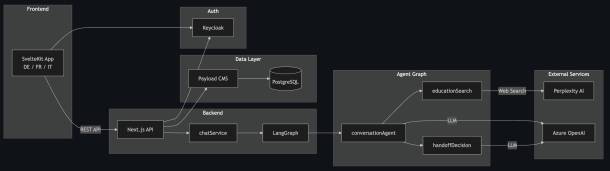
Integrating AI into a chat interface is quick and easy. But for the tool to truly provide advice - rather than just responding - it takes more than a single model call. Three specialized agents now work together in the backend: one for profiling and dialogue, one for search, and one for routing the user to a human advisor.

Before we built this, the architectural question was on the table: How should these agents interact? There are very different approaches to this, and the choice determines how reliable and how expensive the system ultimately is. At one extreme is a fully autonomous system, in which the model itself freely decides what step to take next and which tool to use. This is flexible, but difficult to predict and more expensive to operate. At the other extreme is a rigid process with no leeway. We weighed the options against one another and opted for the middle ground: a clearly defined workflow with decision points at which the system selects the next step based on the situation.

We implemented this using LangGraph, a workflow engine designed specifically for processes like this. It models the system as a graph. Each agent is a node that accesses a shared state - namely, the user’s evolving profile and the conversation history. Conditional transitions determine which agent is next in line. If a search fails, the request is forwarded. If there is enough context, the search begins. A fixed upper limit prevents infinite loops. Inputs are also encapsulated to prevent prompt injection.

For the use case of a consultation, this middle ground was the right choice. The process is transparent, predictable in its behavior, and more cost-effective to operate than a system that acts independently. At the same time, there is enough flexibility for the co-pilot to address various concerns.

Structure 

The system consists of a frontend and a backend, which are built separately from one another. The frontend provides the chat interface for users, while the backend contains the agent logic and the integration with external services.

Sketch of the Co-Pilot architecture: front-end, back-end, data layer and authentication, agent graph and external services

Essentially, three specialized agents work together: 

  • A profiling agent first collects relevant information about the individual and their goals. 

  • A consulting agent processes the request and searches for suitable continuing education opportunities based on the profile. This process utilizes an AI-powered web search powered by Perplexity, which prioritizes industry-relevant sources.&

  • A routing agent determines whether the request can be answered directly or to whom it should be forwarded for human consultation.

For those interested in the full technical details: The complete code for the Co-Pilot, including documentation, is available as an open-source project on GitHub.

Context Engineering

What the agents do is one thing. How they do it is the other. The bulk of the work involves providing the models with the right context so that the end result is what it’s supposed to be. Each agent receives detailed, industry-specific instructions. For example, the Conversation Agent is familiar with typical career paths in horticulture (EFZ, vocational examination, advanced vocational examination, master craftsman certification) and asks no more than one follow-up question per response. Testing has shown that asking too many questions quickly frustrates users.

Content is also weighted. Vocational qualifications take precedence over academic degrees: A vocational training certificate typically leads first to a vocational examination and a professional certification, while a bachelor’s degree tends to lead to CAS, DAS, and MAS. The agents’ responses follow a fixed format to ensure consistency. 

External expertise was also incorporated into this detailed work. The industry associations TreuhandSuisse and JardinSuisse, as well as the consulting experts at emplution, evaluated the co-pilot’s behavior. We incorporated their feedback on what constitutes a good response and what approaches are standard in the industry directly into the prompt and context engineering.

Both of these factors are crucial for such applications: collaboration with experts and an iterative approach that allows us to measure whether a change improves or worsens the result. Without measurement, any adjustment to the prompt is just a hunch. To do this, we use Langfuse to track every model call, including costs and response times, and Promptfoo to systematically test different prompt variations against one another.

How this setup differs from a simple LLM integration

What sets this setup apart from a standard LLM integration is, above all, the conditional routing between agents, a profile that is carried over across multiple steps, structured and verified responses instead of free-form text, and two separate models for different tasks: Azure OpenAI for dialogue and classification, and Perplexity for live web search.

In addition, we used what’s known as “domain boosting”: General AI search favors content that’s easy to find. This often includes universities with strong websites and good search rankings, rather than the vocational training providers that are most relevant to our target audience. In our test, the search query “Gärtner Pool” (Landscaping Pool Specialist) returned a university CAS program instead of the relevant JardinSuisse course.

With Domain Boosting, we can implement the following: For each industry, we maintain a list of eight to twelve preferred sources, for example, jardinsuisse.ch and established horticultural schools for the horticulture sector, or treuhandsuisse.ch and recognized vocational schools for the fiduciary sector. Search results will prioritize these sources without excluding others. University programs will still appear, just not automatically at the top of the list.

However, this is merely a correction, not a solution to the underlying problem. The academic bias is inherent in the web indexes themselves. But we counteract it with our preferred list of sources.

Result

How the tool works for users

Co-Pilot provides users with an overview of relevant, industry-specific professional development opportunities. To get started, there are pre-written prompts that can be used right away, such as:

  • “I’ve completed my apprenticeship and would like to learn about possible paths for continuing education”
    or

  • “I’ve been in the industry for years and am wondering what other opportunities are out there.” 

Users can launch a conversation with a single click or input their own customized goals right away.

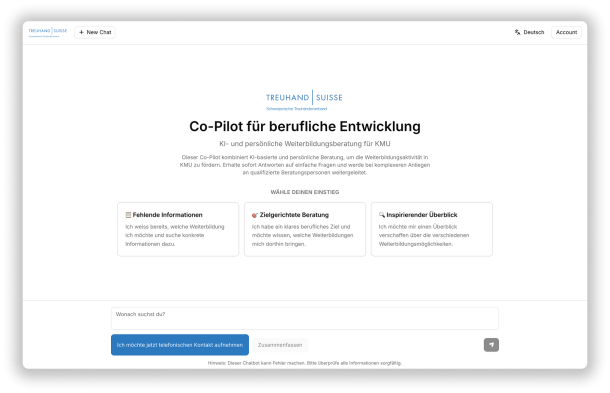
Screenshot of the Co-Pilot for Career Development Home Page
To get started, you can use three predefined options or enter your own.

The chatbot then joins the conversation, outlines typical next steps, and asks: “Would you like to know more about this, are you looking for possible options, or do you want to find course providers and prerequisites right away?”

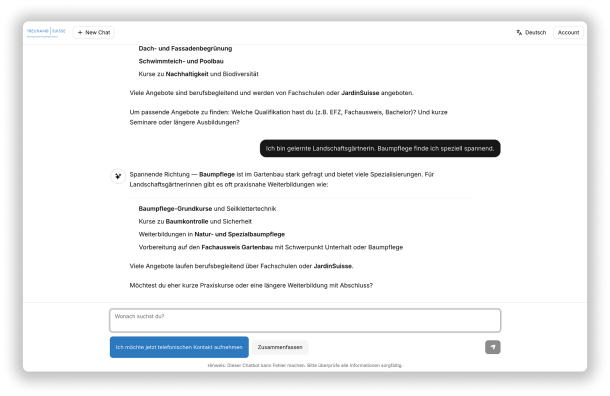
The Co-Pilot's suggestions focus on professional development rather than academic degrees, although these are, of course, also included as options.

Chatbot interface displaying various specialization areas within the field of tree care.
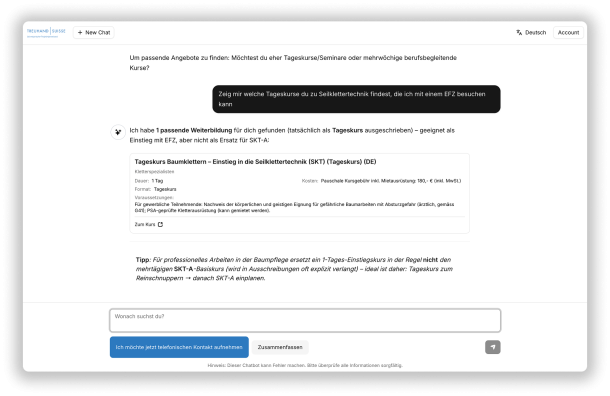
Chatbot interface showing training opportunities and prerequisites for single-day rope climbing courses.
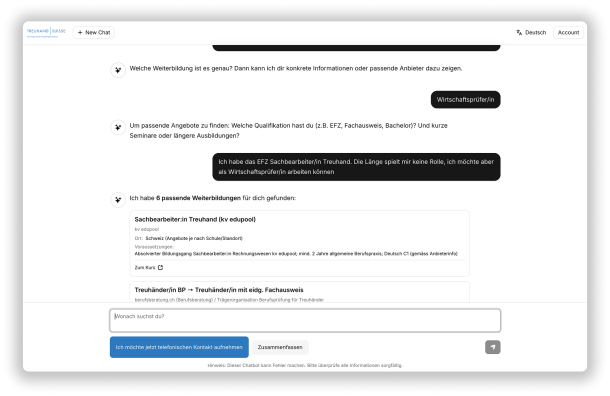
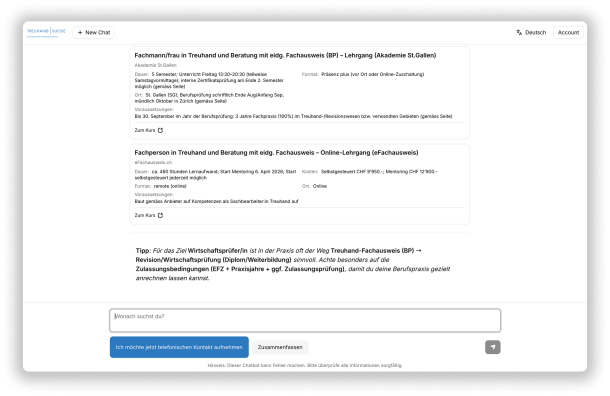
Chatbot interface with specific course recommendations for becoming a certified public accountant.
Chatbot interface displaying course details and practical advice for the fiduciary career path.
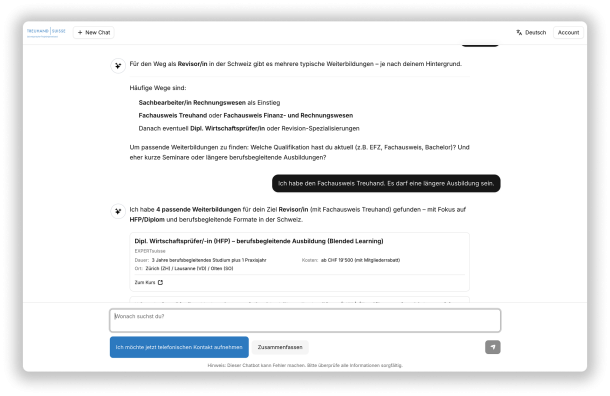
Chatbot interface displaying further education options for becoming an auditor in Switzerland.
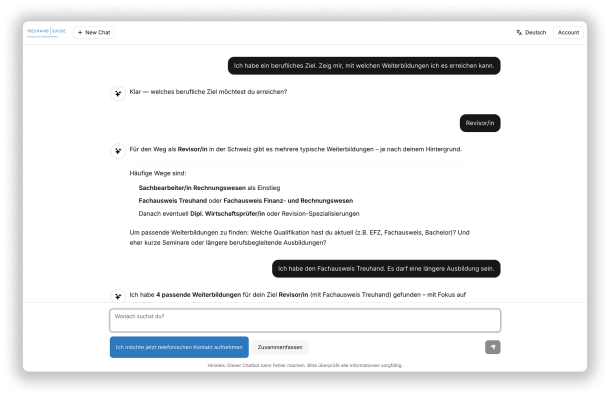
Chatbot dialogue showing the typical career stages and requirements for aspiring auditors.
Verschiedene Szenarien im Kontext von JardinSuisse und TreuhandSuisse und die Antworten des Co-Piloten

Findings from User Research and Testing

The testing sessions primarily focused on specific industry-related questions: What other training programs are available in my industry? How can I get a higher salary? What opportunities would be available if I switched to a different role, such as in administration? And what would it take to make that happen?

The chatbot answers these questions directly and highlights relevant continuing education opportunities. It serves as a first point of contact, shows what’s available, and adapts to the user’s individual situation. For more complex issues, it refers users to qualified advisors.

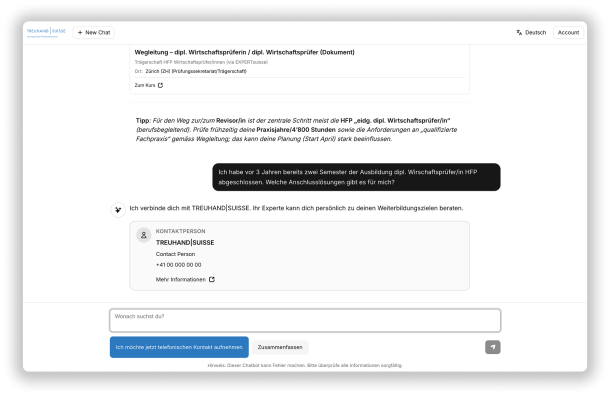
Chatbot UI when the Co-Pilot provides a person's contact information in complex cases
In more complex cases, the co-pilot connects the user with an expert from the relevant industry association.

User testing showed that younger users, in particular, have embraced the tool and appreciate the opportunity for interactive engagement. Specific industry knowledge is a key differentiator here, as it sets the application apart from general AI chatbots.

At the same time, it became clear that the chat histories reveal very different interaction patterns. The chatbot does not engage with everyone equally well, and for some issues (e.g., recognition of diplomas), users prefer to speak with a human advisor. The majority of users surveyed expressed satisfaction with the tool’s user-friendliness and found it easy to use. Younger users tended to interact more with the Co-Pilot and were generally more satisfied. 

The Co-Pilot we've created is highly versatile. This opens up a variety of expansion options and use cases:

  • Industries and skills, Differentiation for specific occupational fields (e.g., AI-exposed professions) or situations (e.g., those specific to apprenticeship graduates or managers)

  • Integration of learning coaching, vocational/practical training, or similar

  • Technical enhancements such as MCP integrations (access to structured course data) or database integration

Evaluation of Our Approach for Tool Providers

From the provider's perspective, the following advantages can be identified:

  • The existing tool is relatively easy to expand. For example, if you want to provide advice on continuing education in a new industry, this requires a new list of sources and customized prompts, but no new code. A centralized knowledge graph with its own data pipeline would have been significantly more complex to build and maintain.

  • The cost per user query remains low. We do not operate our own search infrastructure or maintain a course database. Even with 1,000 users, the pure model costs are less than 150 Swiss francs per month. The majority of this cost is attributable to web search, not the language model. This also makes the tool scalable.

  • The trade-off for this approach is transparency rather than full control. We gain timeliness, scalability, and low maintenance costs, but we forgo the complete verifiability of every single data point that a proprietary, curated database would offer. From our perspective, this is a sensible approach toward the goal of providing a low barrier to entry.

Findings & Outlook

The Co-Pilot is useful because it offers an interactive, step-by-step process that places the user’s personal context at the center. This is what makes it truly valuable, and it is primarily this that distinguishes it from general-purpose chatbots like ChatGPT in the eyes of users. To deliver this value, a great deal of context engineering is required so that the tool uses the available resources correctly and ultimately does what it’s really supposed to do. This part is fundamental and should not be underestimated: Integrating an AI is relatively quick. Getting it to work the way you want, however, requires expertise and time.

To assess how well the model works, validation is important. With AI-integrated products, this differs significantly from traditional software: you can’t directly check whether something works, for example, “Does the button light up green when I click it?” An AI’s output must be evaluated in terms of content, form, and user-friendliness. This requires subject-matter knowledge and expertise to assess whether a response makes sense and is helpful. Accordingly, this, too, requires time and attention.

Last but not least, the use of domain boosting in particular highlights the importance of well-structured websites when AI tools need to find content (keywords: sitemap, structured data). This has a direct impact on how visible organizations and their offerings are in an AI-driven search environment. The good news is that you can actively optimize and improve this. We’d be happy to help you with this: learn more in our offerings for web apps and websites.

We are eager to see how this pilot project and the tool we've created will turn out, and we look forward to continuing to play an active role in its development.

For us, it was an exciting project that challenged various aspects of our skills and culminated in a pilot project with real users that yielded many insights. Context engineering was the central focus and will likely remain so for the next few years. At the same time, the field of AI integration is evolving rapidly. This is precisely what the project demonstrates: it pays to stay flexible. Those who don’t rigidly cling to their initial concept can incorporate better solutions along the way and ultimately get much more out of the project.

Do you have any ideas on how you’d like to integrate AI into your project? Or would you like to know how an AI co-pilot could work in your context?

Overview
Stephan Klaus
Stephan Klaus
CEO | Co-Founder
Maintains the overview when the through-view isn’t possible. Also known as Mr Gadget because he’s on a first name basis with every device imaginable. His expertise is extensive. Ask him anything you want and he’ll know the answer.
Maximilian Lemberg
Maximilian Lemberg
iOS Development & AI Engineer
Maxi is an initiator and creates enthusiasm not only on trial days, but also at team outings, hackathons, thirsty fridays, basketball games - in fact at any kind of event. Thanks to his DJ sets, even at office housewarmings no one sits still and the team stays motivated. Or as he would probably say: hyped.
Milena Rutz
Milena Rutz
Head of User- and Innovation Research
She uses scientific methods to find the key issues that are all decisive for hit or flop. You’d better listen to her and do exactly what she says: her know-how is worth its weight in gold.
Tobias Minder
Tobias Minder
Project Management
He has all the elements of successful project management under control: staying power, the right dose of caffeine, responding to the unexpected and skilful steering. No wonder - as an early riser and coffee connoisseur, he has enough time and energy to perfect his skills while diving, mountainbiking or surfing.
Stefan Spieler
Stefan Spieler
Concept & Design
Design professional in all aspects. Has a beard now but is still up for every sort of goofing around when it comes to design, games, 3D, table tennis, swimming, horse riding or reading. One of the first with us and still one of the nicest.
0:00
0:00