The aim of a development phase is to create a digital product that delivers real value and meets all requirements. Software testing is a vital piece of the puzzle along the way. We bring the experience gained from hundreds of projects to ensure exactly that – both within our clients’ projects and as a standalone service.
Why test design and test management are essential

Software testing is not a final project step, but rather accompanies development from the very start and continues throughout the entire project. There are two fundamental aspects to this:

  • Testing the right things (effectively): What needs to be tested to ensure that the product meets all requirements and delivers the expected value?

  • Testing things right (efficiently): How do we proceed to ensure that software testing runs efficiently and achieves its goals?

In this context, quality means more than just ‘it works for the users’. A good product is also reliable, maintainable and well-structured in areas that users never see directly. A properly structured software testing approach combined with expert guidance achieves exactly that: a software product of high, sustainable quality. We adhere to the criteria of the ISO 25010 standard (Software Quality) while our staff are certified according to HERMES, and our software testers additionally hold ISTQB certifications.

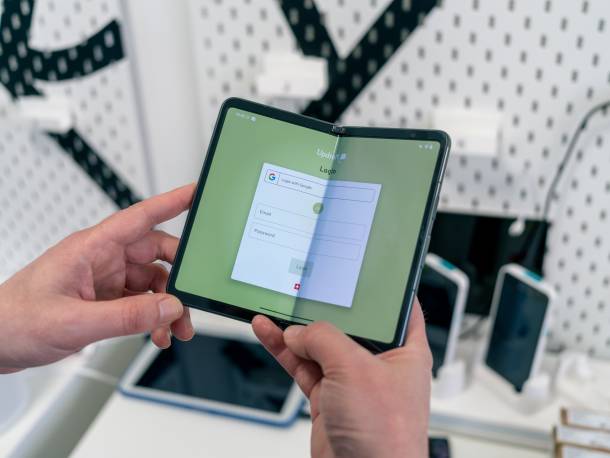
Updraft login page, open on a Google Pixel Fold
Our Device Wall offers a wide variety of devices so that developers and testers can view, check and test software at any time.

How software testing with Apps with love can look

Test design and test management are integrated into our workflows in versatile ways. While it is a standard part of every project we build, we also offer it as a standalone service. Depending on your situation, we can collaborate with you in different ways:

  • In our projects, software testing is an integral part of the process and is involved right from the start.

  • As an external partner, we create test concepts, plans, and strategies for teams that want to structure their software testing or hand it over to an external testing team.

  • We also offer targeted software testing for specific test cases. This is for companies looking to secure their existing or newly developed digital products, whether it involves designing test cases or handling the actual "software testing" execution. 

No matter if you are at the beginning of a software project, want to secure a live product, or need to bring more structure to your software testing process: we will find the right way to work together.

Generally speaking, software testing can be divided into two main dimensions.

Dimension 1: Test planning and test design

Even before development begins, it’s all about getting things on the right track. By following the steps below, we should work together to lay the foundations so that software testing is effective from day one.

Capturing the big picture

What is the product intended to achieve, and what does it take to get there? We clarify the objectives, gather the requirements, and identify which aspects of the product must be tested to guarantee the desired value.

Define the project structure

  • We outline the relevant test types and in which project phases they should be deployed.

  • We set priorities to ensure a smooth process, identify risks early and manage dependencies effectively.

  • We define what is to be tested and how: where software testing can be automated, where automated CI pipelines are appropriate, and how we cover edge cases.

  • We establish the project methodologies: do we work using Agile or the Hermes framework? What artifacts are required?

  • To draw up a roadmap, we map out timelines and dependencies: when does each type of testing take place, what requires lead time, and what needs to be agreed together.

Roles and collaboration

  • Roles are clearly defined: we clarify who tests what, what role the client plays in testing, at which stage of the project testing begins, and who the points of contact are for specific types of testing.

  • Communication channels are established so everyone has the right information at the right time. For example, what does error and bug management look like? How and in what format are bugs reported? Where does acceptance testing take place? 

Test planning and test design are not one-off tasks; we continually review whether the approach is still effective and adjust where necessary. The outcome may be a detailed test plan. Often it takes the form of a test strategy, defined test processes, test scenarios or other quality measures.

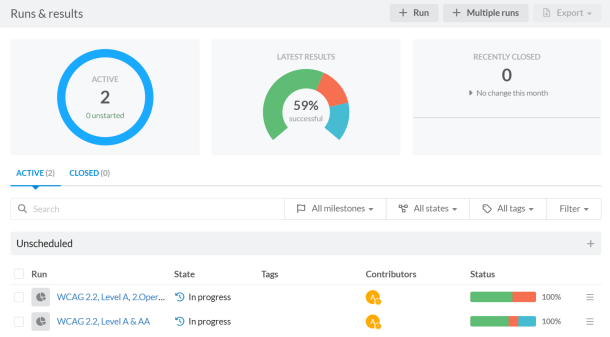
Screenshot from the Testmo Testing Tool showing active tests and the Results Dashboard
A look at a dashboard in ‘Testmo’, the testing tool we use.

Dimension 2: Test management

Once the foundations are in place, the ongoing guidance and coordination begin:

  • Timing: the right tests at the right time. Performance tests, for example, require lead time and coordination.

  • Preparation: Providing test data, access credentials and systems ahead of time, whether using production-like environments or synthetic data.

  • Documentation & collaboration: Documenting test cases and test scenarios, generating ongoing test reports, documenting evidence, and ensuring seamless collaboration. For this, we use established tools like Testmo or Jira

  • Quality measures: Quality assurance measures accompany the entire process. These include "Definition of Ready" and "Definition of Done", requirements analysis and testability of requirements, code reviews, automated testing, automated build, test and deployment processes (CI/CD), and transparent issue-tracking workflows.

At the end of an engagement, there is a formal handover with clearly defined acceptance criteria and a complete handover.

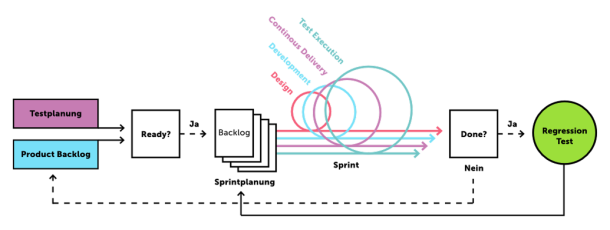
Process visualisation from test planning through to regression testing
Process visualisation for quality management

The value and future of software testing

Software testing has always been central to product quality. And it will remain so, even as (and especially because) AI fundamentally transforms the development of digital products. Because AI allows faster and greater volumes of production, the output must be tested accordingly. Good test management ensures that this happens effectively, efficiently and in a way that is adapted to the respective context.

However, AI is also changing software testing itself. It is already in use across various areas: generating test cases, identifying edge cases, running automated tests, and more. This field is constantly evolving. At its core, smart conceptual design remains essential to ensure that software testing – with or without AI – works in a targeted and effective manner. We deploy AI where it makes sense and are constantly adapt to whatever new developments emerge.

Ready for better software testing?

Whether you are building a project with us, looking to secure an existing product, or wanting to better position your organization: we are happy to hear from you!