Compass Integration – Working tools for integration work

8. January 2026 - from Maya Walther

What is needed to make personal integration opportunities and processes for refugees more understandable and transparent for all involved? This question was at the beginning of our collaboration with inklus.io on the "Compass Integration" project.

Like us, the project initiators believe that (digital) products create the greatest value when end users are involved in the development process. That is why an interdisciplinary team was put together to develop, prototype and test ideas in a collaborative process, in order to create tools that meet the needs of those involved in the integration process.

In this blog post, we give you an insight into the development process of the "Compass Integration".

Starting point for the "Compass Integration" project

Every year, between 20'000 and 30'000 refugees apply for asylum in Switzerland. Around 60% of them are granted protection and remain in Switzerland long term.
Achieving financial independence after that is not an easy process and, above all, a long one. Around 4 out of 5 refugees are dependent on social welfare for several years. In order to become financially independent, they need to acquire language skills and key competencies for life in Switzerland, as well as recognised qualifications.

This path to integration works best when refugees, social workers and job coaches work together towards the same goals and can clearly communicate expectations and next steps. Today, there is often a lack of supportive tools to achieve this. This is where the Compass Integration comes in.

The Integration Compass is a pilot project by inklus.io, which is being carried out in the first project phase in cooperation with the cantons of Basel-Stadt, Bern, Graubünden and Lucerne, as well as the State Secretariat for Migration (SEM).

Apps with love is jointly responsible for the design and development of the working tools as an implementation partner. Another implementation partner is illustrator Patrick Oberholzer.

The design of the integration process

In 2019, the federal government and the cantons agreed on a joint integration agenda (IAS). This defined binding targets and processes to integrate refugees and temporarily admitted persons more quickly and reduce their dependence on social welfare.

The cantons are responsible for implementing measures to promote integration. For example, they ensure that refugees have access to information and advice on language courses, educational opportunities and the labour market.

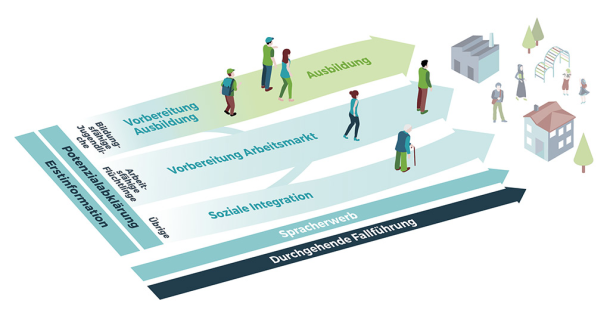
A core element of the integration agenda is "continuous case management". This refers to the comprehensive support provided to an individual from the moment they arrive in a canton, on their path to linguistic, professional and social integration.
Despite overlapping responsibilities and varying time limits, continuous case management is intended to ensure continuity, needs-based support and goal orientation during the initial integration process.

Graphic continuous case management
Swiss Integration Agenda, image source State Secretariat for Migration

Case managers work with their clients to clarify their integration prospects and plan the individual integration process. They coordinate and document the collaboration with clients and other parties involved, such as job coaches, health or education professionals. The case manager analyses the client's initial situation and draws up proposals for the next steps in the integration process.
Clients are responsible for achieving their individual integration goals. They communicate independently with relevant contact persons and inform the case manager of any new developments. At regular intervals, the achievement of goals is reviewed, documented and further measures planned.

The idea behind the Compass Integration – why new (digital) tools are needed in integration work

inklus.io has been involved in case management in the asylum sector for several years. Through discussions with case managers and refugees, it was determined that there is a lack of suitable tools that professionals can use to communicate goals and expectations to their clients in a way that is appropriate for the target group, plan the next steps, and map out the process in a clear and understandable manner.

The aim is to create suitable tools that provide optimal support and guidance for the joint design, planning and implementation of the integration process: the Compass Integration is intended to provide greater orientation in the integration process and improve communication between case managers and refugees.

Various working tools within the Compass Integration are designed to ensure that

  • discussing integration is simplified

  • integration prospects and processes become more transparent and easier to understand

  • cooperation between case workers and refugees is simplified

  • areas of life become visible in which an active contribution to integration can be made

  • refugees are increasingly able to obtain information independently and contribute to shaping the integration process 

The working tools are designed in line with the core process of continuous case management.

About inklus.io 

Inklus.io – that's Annina Indermühle and Beat Habegger. As a general partnership, they offer services in the areas of integration, work, education and digitalisation.

Beat and Annina have been engaged with the topic of case management in the asylum and refugee sector for several years. In the course of their work, one central problem repeatedly came to light: there is a lack of target group-tailored tools to support professionals and clients in planning the integration process and discussing goals and expectations together. This gave rise to the idea of developing a tool that would support both the work of case managers and the participation of clients.

Step-by-step approach in an interdisciplinary team

To ensure that the Compass Integration and the working tools it contains meet the needs of case managers and refugees, solutions were developed by an interdisciplinary team of experts from the fields of social work, integration promotion, software development and design.

Possible approaches were developed in several workshops using human-centred design methods. The solution ideas were gradually refined, evaluated and prioritised, and reviewed several times with various experts.

Inklus.io organised and led the workshops, while we at Apps with love provided support in our role as software development, UX and design experts, offering input on technical feasibility and user-centred design.

In the first workshop, the existing foundations (process of continuous case management, areas of action and possible solutions) were enriched and supplemented with the participants' perspectives.

The aim of the first workshop was to bring together the perspectives of the various stakeholders: What are the areas of action for possible working tools? How are these currently structured? How is integration discussed? What experiences do refugees have? What are the factors for success?

Various ideas for working tools were presented. Participants were able to give their personal assessments and contribute ideas for further development. The results were discussed in a plenary session. The various ideas were then evaluated and prioritised.

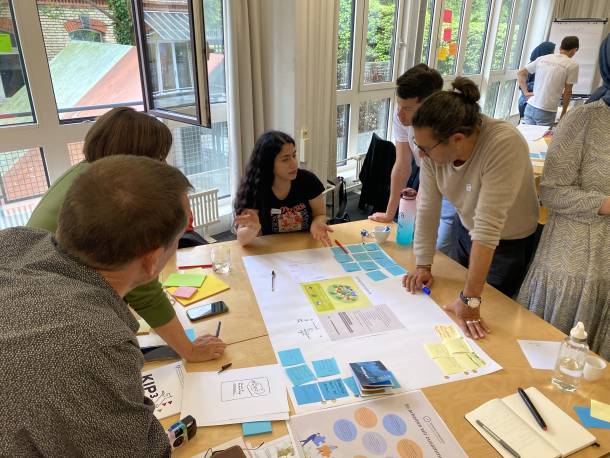
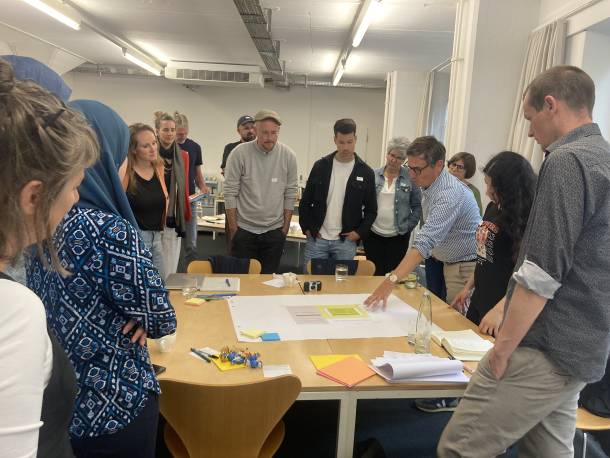
People stand and sit around a table, collect ideas on post-its and discuss them
One person explains what is written on a sheet of paper on a table. Other people stand around the table and listen.
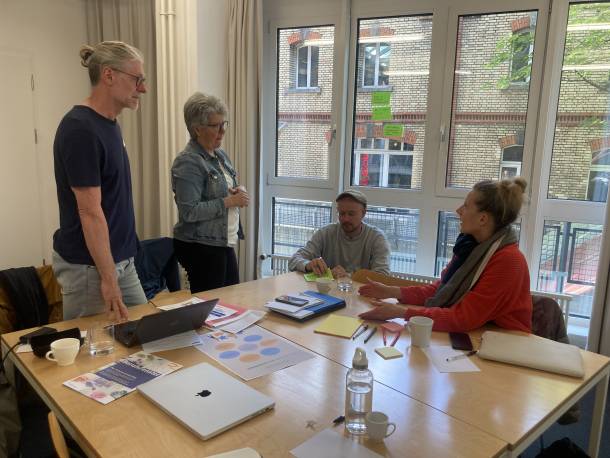
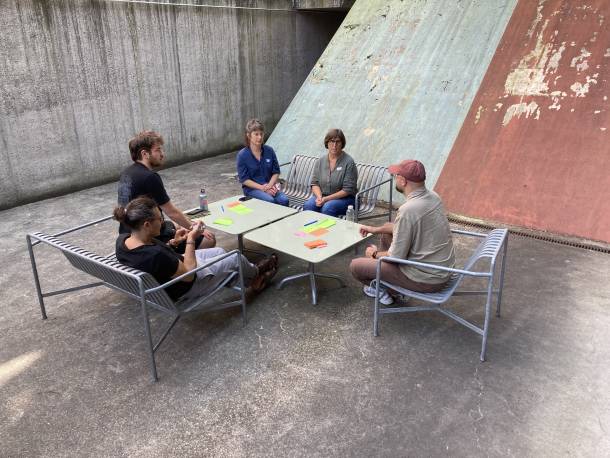
5 people are sitting outside around a table talking. There are post-its on the table.

Between the first and second workshop, we designed initial wireframe-based prototypes based on the developed ideas. These were tested in the second workshop to check whether we were heading in the right direction. Only then were the prototypes further refined based on the feedback we received.

Various working instruments as outcomes

This has resulted in prototypes of various working tools, which can be refined and implemented after further validation and feedback rounds. They can then be used in counselling sessions and for preparation and follow-up work.

Integration landscape

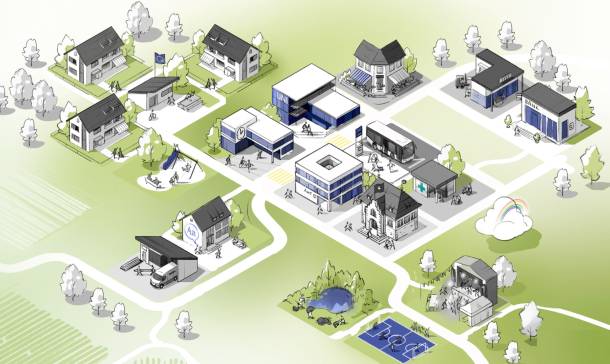
The integration landscape visualises the topic of integration in an universal overview and highlights the various areas of life in which integration takes place. The integration landscape also introduces the imagery that is used in the working tools.

Integration landscape - illustrates areas of life in which integration can take place
Integration landscape illustrated by Patrick Oberholzer

The integration landscape and all the resulting image components were illustrated by Patrick Oberholzer. He is a freelance illustrator and author whose work also deals with the stories of refugees. In his book "Games", a documentary comic, he recounts the experiences of five people from Afghanistan before, during and after their flight.

Annina and Beat from inklus.io became aware of Patrick Oberholzer through the book and asked him to illustrate the visual world of Compass Integration.

"Paths to Integration"

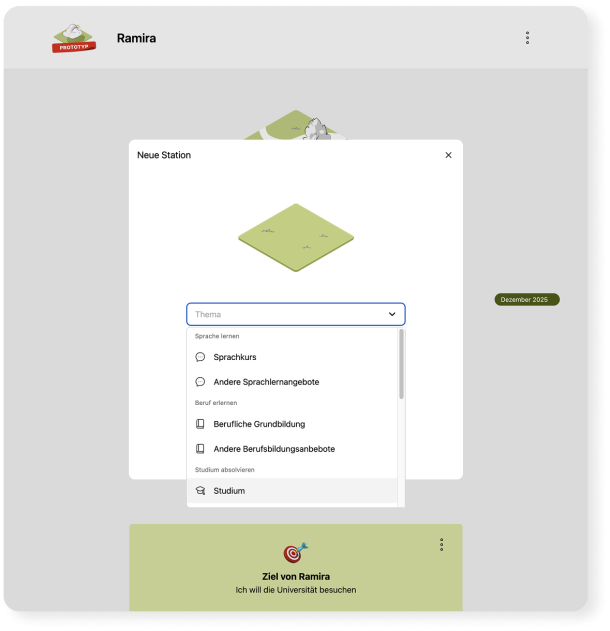
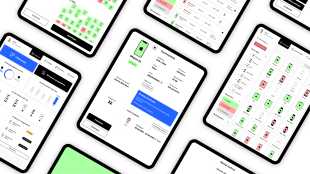
During counselling sessions, case managers and refugees formulate individual goals in the areas of language acquisition, education and employment. The "Paths to Integration" tool can be used to visualise different ways of achieving these goals. This allows different paths to be compared and the requirements, advantages and disadvantages to be discussed. The "Paths to Integration" tool has been implemented as a web application. No login is required, and the data entered is stored locally.

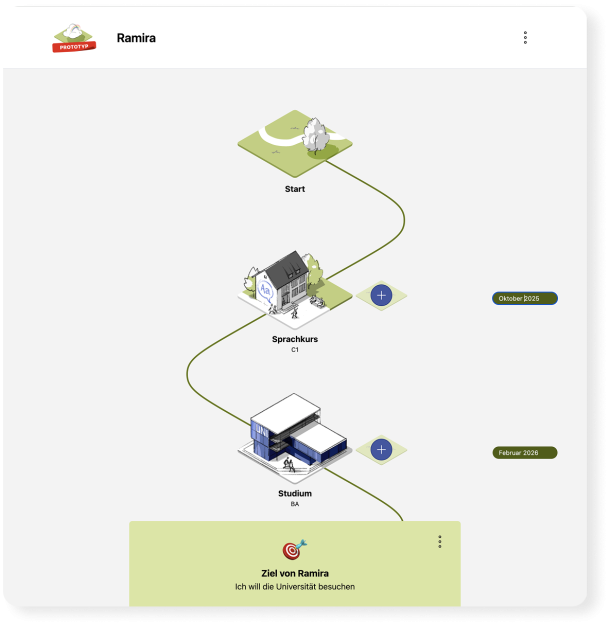
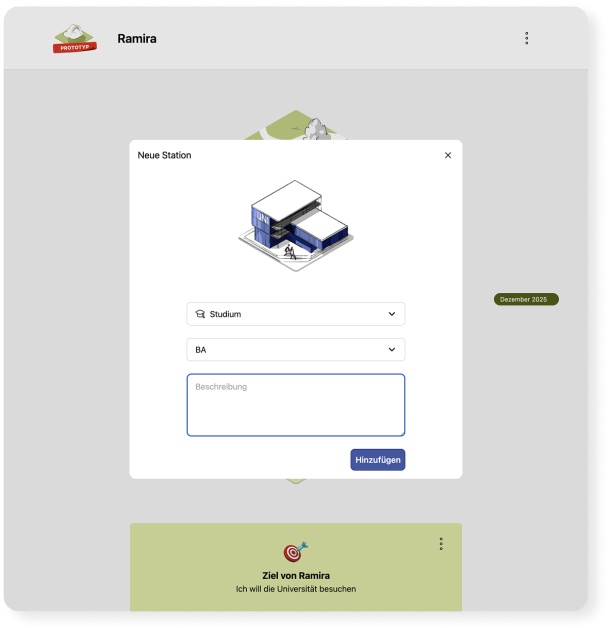
New paths can be created from scratch or using templates. The individual steps are grouped by topic and include predefined categories. If a step on the path is, for example, basic vocational training, you can choose between a trial placement, pre-apprenticeship, EBA, EFZ or vocational baccalaureate. The individual steps can be moved using drag & drop and supplemented with descriptions and data.

For better visualisation and recognition, the illustrations from the integration landscape are also included in the "Paths to Integration" tool. The tool is intended to be an aid that accompanies the people involved over several years, in the spirit of continuous case management.

Paths to integration - Ramira's exemplary path with two stations
Paths to integration - add new station
Paths to integration - Study station

"Where I stand"

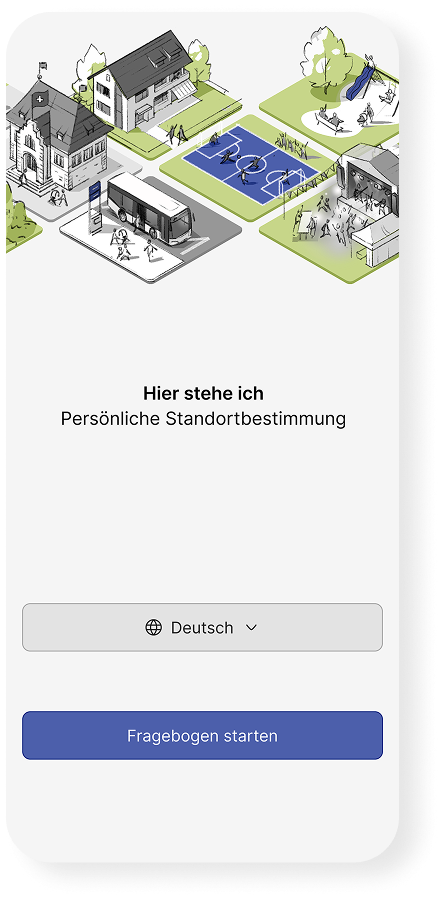
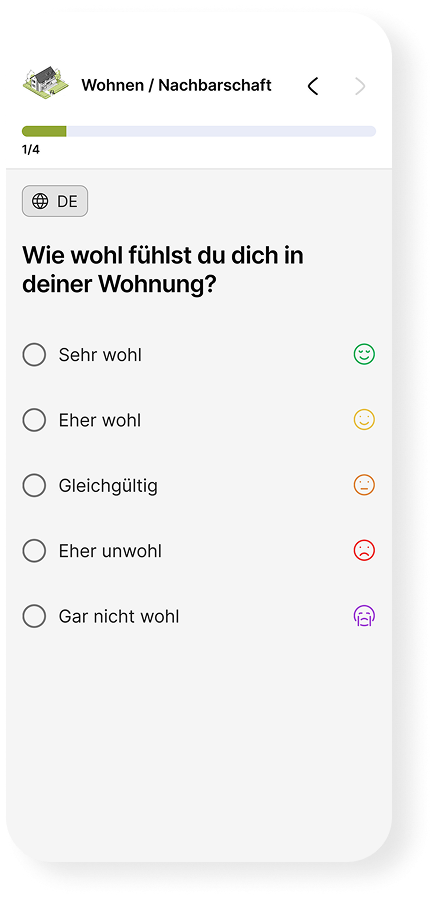
With the help of a digital questionnaire, refugees can assess their personal situation with regard to their social integration. This assessment helps to identify issues that can be discussed with the relevant specialist and serves as a basis for formulating goals and concerns.

The questionnaire was initially implemented as a prototype using Figma and serves to illustrate how personal assessment could be carried out.

Here I am: start questionnaire for personal assessment
Question 1 from the questionnaire: How comfortable do you feel in your flat?

"Refugees tell their stories" and "How it works"

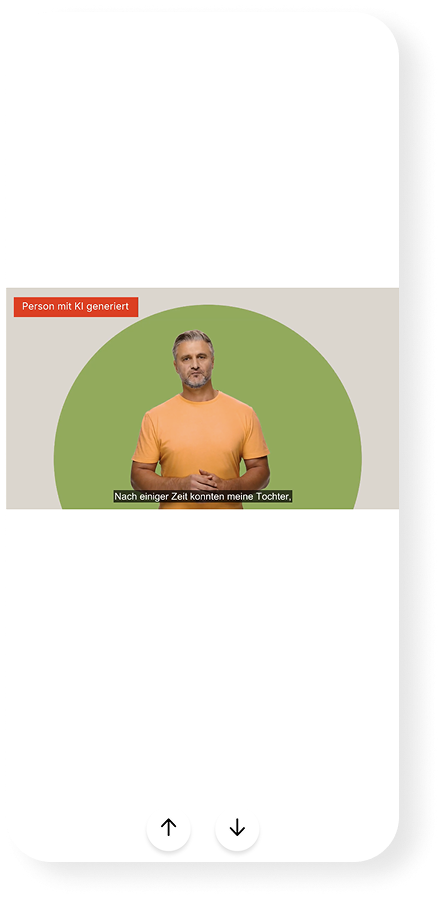
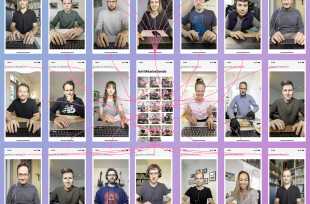
In video portraits, refugees share their experiences and, as well-informed peers, pass on tips for overcoming obstacles to integration. This allows other people to gain insights into different paths to integration and benefit from the knowledge and experiences of others. AI-generated video portraits are used for the current prototype.

Information on life issues and their importance for integration is also available, both in text and audio format and in all relevant languages. This is intended to help refugees independently engage with the areas of life in which integration takes place.

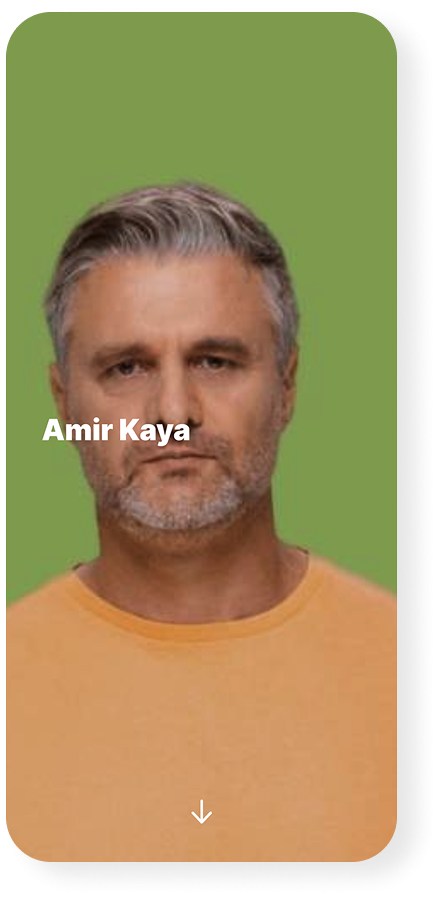
Refugees tell their stories: Amir Kaya
Refugees tell their stories: Amir Kaya, video generated with AI
How it works: Explanation of how an apprenticeship works in Switzerland

Further materials

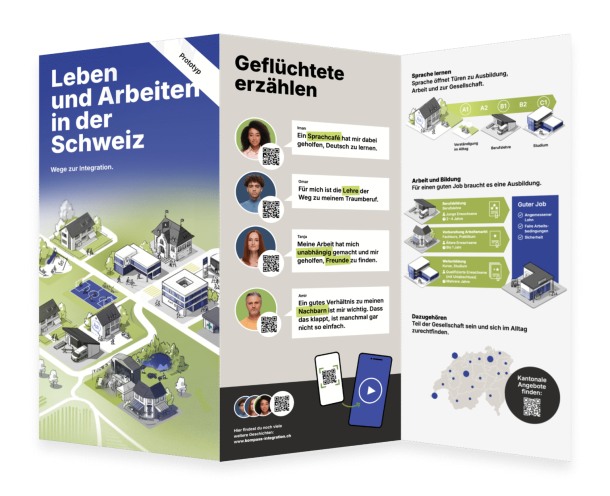
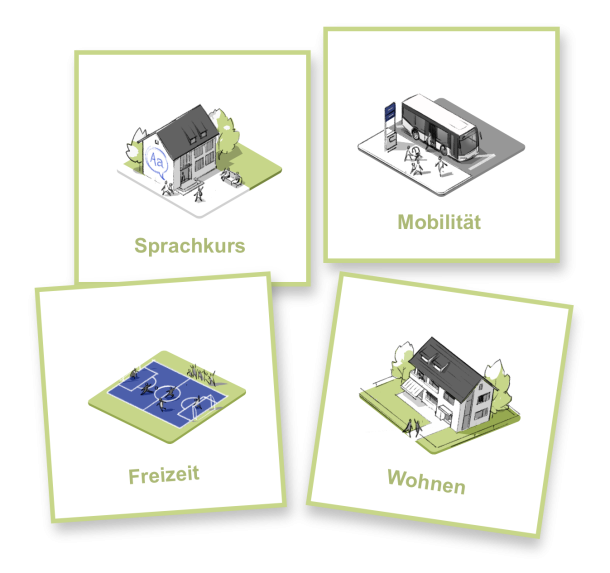
Additional (printed) materials supplement the Compass Integration tools. The range of services is described and made available in a compact flyer. Coaching cards serve as a further aid that can be used in counselling sessions for illustration and to facilitate mutual understanding.

Flyer about the Integration Compass
Coaching cards as a working tool of Compass Integration
Flyers and coaching cards for consultations

What happens next?

The prototypes of the various working tools were recently tested in practice – by case managers and clients. The entire "package" of tools was tested and feedback was collected. The results are positive: the Compass Integration is perceived as a useful and intuitive tool that provides guidance and facilitates cooperation.

Based on these findings, the tools will be further refined and developed in detail in the future. The aim is to develop the tried-and-tested ideas into a stable product suitable for everyday use that provides sustainable support for integration efforts.

At the same time, discussions are underway with various cantonal authorities to involve other cantons in the project. A broader introduction of the Compass Integration would create new opportunities for professional exchange – on how the tools are used and what constitutes good case management. In this way, the Compass Integration is gradually developing from a promising prototype into an effective tool for integration processes.

Collaborative processes result in (digital) products that simplify life.

Our aim is always to focus on the end users of a digital product and to integrate them as much as possible into the development process. This is the only way to create tools that deliver real value to users. Compass Integration is an exemplary project in this regard, and we are delighted to be part of the interdisciplinary project team.

Several factors have contributed to the development of working tools that are both comprehensible and helpful for case managers and clients alike. The Compass Integration project was not fully mapped out from the outset, but was a deliberate journey of discovery. Through collaborative workshops, early prototypes and testing, it became clear what was helpful for end users and which initial assumptions had to be discarded or corrected. The value of the collaborative and iterative process became clearly apparent.

The fact that the project was initiated by professionals who were themselves involved in integration work, rather than coming from the top down from the administration, also helped to maintain a close connection to the reality of case management.

Nevertheless, it should be noted that the Compass Integration is to be used across cantons in future. Accordingly, the various requirements, wishes and expectations of the cantons will have to be taken into account – a challenge and complexity that should not be underestimated. However, we are convinced that there will be a way to design the tools in such a way that they provide sufficient guidance on the one hand and leave enough leeway for different contexts on the other.

We are sharing insights into this project because we are convinced that digital solutions – especially in the social area – can only be effective if they are developed together with the people who use them and if the process is transparent. For us, the Compass Integration project is a good example of what can be achieved when people listen actively, try things out and make gradual improvements.