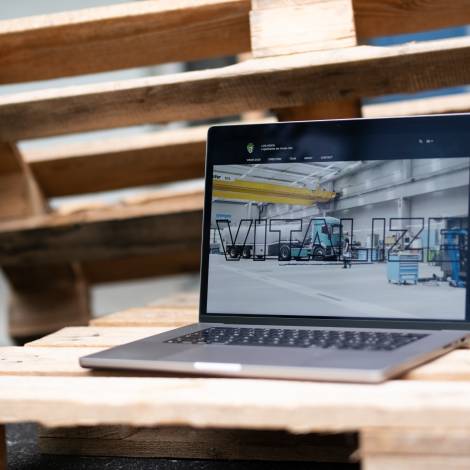

Many of the applications we use daily are actually web apps. So it only makes sense that we implement many web projects – even though we aren't called "Web with love". About half of our project portfolio is built using web technology. This includes traditional websites as well as Progressive Web Apps and complex web tools. Along with the endless possibilities offered by the modern web come various challenges and aspects to consider: a vast range of devices and browsers, accessibility, SEO, and much more. We master these with extensive expertise and experience.
Our expertise in web development
Our mission is to develop web solutions that simplify people's lives. We create responsive designs to ensure your web solution is displayed optimally on all desired devices – whether desktop, tablet or smartphone. The graphic design of a responsive website is based on the requirements of the specific device used to view it. This particularly affects the arrangement and presentation of elements such as navigation, images, and text, as well as the support for different input methods like mouse or touchscreen.
During implementation, we also take important accessibility factors into account and ensure that all technical requirements for high discoverability in search engines and AI models are met. Key terms here include: structured data and SEO.
Progressive web apps (PWAs)
A progressive web app (PWA) is a website that possesses many features previously reserved for native apps. It can therefore be described as a symbiosis of a responsive website and an app.
In addition to their characteristics as websites, progressive web apps offer numerous special features that are familiar from native apps:
Offline availability
Sending push notifications
Access to certain device functions
Add-to-home-screen function for quick and direct access
The basic requirements to qualify as a PWA are minimal: You need:
A TLS-protected connection, recognizable by the https
A JSON manifest, i.e. a small file that defines elements like icons, names, and the start URL. An overview of the possibilities can be found at web.dev – in a project, we work with our clients to determine the right configurations.
A service worker: This is a piece of code that runs in the background to handle tasks. We've provided an overview of the technology in this blog.
It sounds simple, but the practical implementation of a service worker can become quite demanding depending on the complexity of the web application. We're familiar with the possibilities and limitations of PWAs and can assess in which cases implementation as a PWA makes sense, when a "normal" website is sufficient or when a native app is necessary or more appropriate.
Traditional websites
A website is often the first point of contact and therefore crucial for a good customer experience. Is the website visually appealing? Can I find what I’m looking for? does it perform well? A website doesn't just share information, it conveys a company's values – accordingly, it must be carefully maintained.
We help with the implementation of larger (corporate) websites and offer all of the services you need for a successful implementation from a single source.
In some cases, a custom-built website may not make sense due to specific requirements or budget constraints. Even in these instances, we're happy to offer support, using site builders or AI-driven tools to create landing pages or smaller websites.
More complex web tools such as web configurators
An appealing website is important, but the full potential often lies in digital solutions that transform processes and thus create profound added value. In the B2B sector in particular, products and processes often require intensive consultation, and off-the-shelf solutions such as a standard online shop aren't sufficient.
We build custom tools that transform processes in a way that creates a win-win situation. A classic example is a configurator, which allows customers to assemble their own desired solution and receive a cost estimate much faster than through a manual process.
E-commerce solutions
Software solutions in the e-commerce sector are specifically tailored to the respective use case. We cooperate with partners for extensive online shops. For simpler shop solutions, we rely on integrations with Shopify or Shopware.
State of the art web tech stack
Our web front ends are based on the W3C standards HTML, CSS and JavaScript or TypeScript. For web applications, we use the React and Svelte frameworks.
Customized implementations, for example with Vue.js or Angular, are also possible by arrangement.
CMS - Statamic, Livingdocs oder Payload
A content management system (CMS) is software used to create, edit and organize content, mostly on websites or apps, but also in other media formats. A CMS can be operated via a graphical user interface without the need for programming or HTML knowledge.
In most cases, we rely on Statamic for our web projects. Statamic meets our high standards for a modern, high-quality CMS, both in terms of technical implementation and user experience.
Statamic can be used to build almost any type of website. By default, it operates as a "flat-file" CMS. This means that in its standard configuration, it bypasses databases, providing a fast and productive way to create and manage creative, tailored websites. Furthermore, it allows you to keep not only your code but also all of your content within version control. However, a database can be added at any time, making large-scale projects with vast amounts of content easily manageable.
Since Statamic is based on Laravel, the most widely used and secure PHP framework, websites built with Statamic aren't only fully customizable and expandable, but also very secure. What's more, we're an official partner of Statamic, which gives us a direct line to the development team, which naturally benefits our clients.
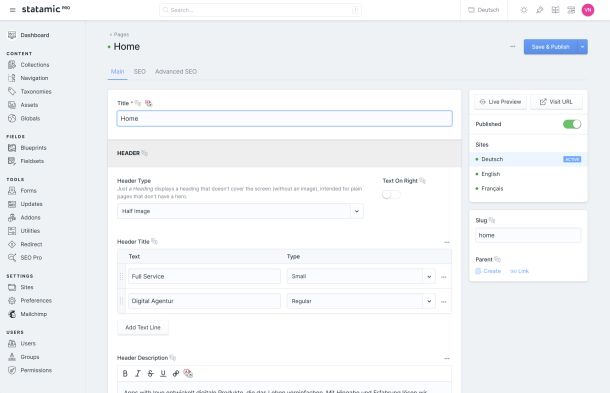
Example page in Statamic CMS for maintaining web content.
In addition to Statamic, Livingdocs and Payload are also part of our tech stack. In 2022, Livingdocs was selected as the foundation for all web presences of the Swiss Confederation and the Federal Administration. Livingdocs is particularly well-suited for collaborative work.
Payload CMS is our favorite for managing data in web applications. Payload allows for the creation of databases to manage data and automatically provides an admin interface and an API for the defined data. This interface is crucial for web applications and integrates seamlessly with third-party systems.
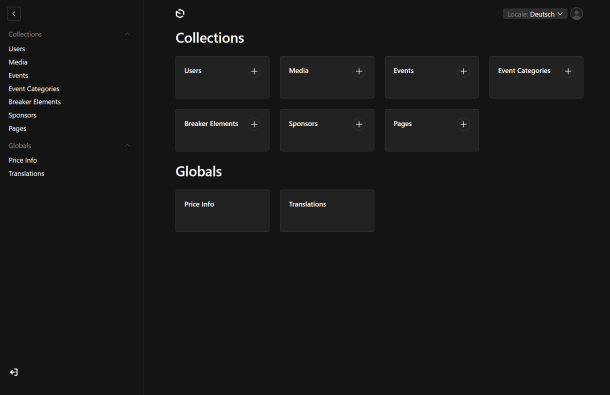
The Payload CMS user interface
Further support in the web area
A successful website requires more than just responsive design and high-quality technical implementation. Above all, it needs content. If required, we can support you – also in collaboration with partners – in all areas of content development (text, images, audio or video content), UX writing, SEO and in the field of brand development (branding).
Featured web projects
From websites for information transfer (such as Logvision based on Livingdocs), configuration tools such as the system calculator for Pestalozzi Stahltechnik implemented with Statamic, to event calendars like "le petit calendrier" realized with Payload:
We have a wide range of experience and will find the right solution for your project too.